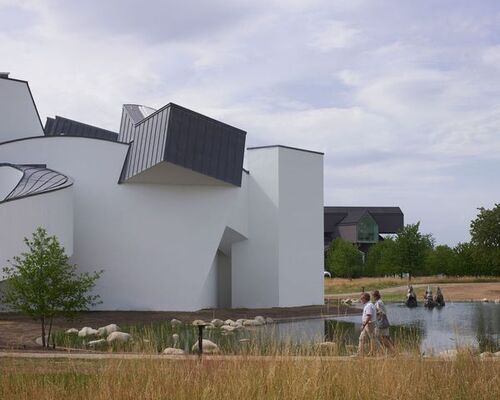
Swiss furniture manufacturer Vitra has unveiled a major landscape project designed to improve biodiversity, manage water and increase climate resilience across the Vitra Campus in Weil am Rhein, Germany.
Created by Belgian landscape architect Bas Smets, the new Water Garden soft opened on 17 June during Art Basel and to the public from 18 June.
The official launch will take place on 4 July as part of the Vitra Campus Summer Festival.
The garden forms the latest phase of a long-term ecological masterplan that reimagines the Vitra Campus as what Smets describes as a "living organism" capable of adapting to changing climatic conditions.
Located in front of the Frank Gehry-designed Vitra Design Museum, the project centres on a large pond surrounded by trees and aquatic planting selected to support biodiversity and withstand future climate pressures. The water feature is supplied by rainwater harvested from the roof of a neighbouring factory building, while a landscaped berm created from excavated soil helps protect the site from a nearby road.
According to Vitra, the pond and its vegetation have been designed to attract birds, support fish populations and create new habitats for wildlife, bringing additional ecological value to a campus better known for its collection of world-famous architecture.
The project forms part of a broader transformation programme begun by Smets in 2022. The first phase involved the planting of 8,000 young trees using the principles developed by Japanese botanist Akira Miyawaki, creating a series of dense micro-forests intended to accelerate ecological regeneration and restore biodiversity across the site.
The Vitra Campus has evolved into a significant destination for contemporary architecture and design. Following a fire that destroyed much of the original factory complex in 1981, Vitra commissioned a succession of architects to design replacement buildings, creating a collection that includes works by Frank Gehry, Tadao Ando, Zaha Hadid, Herzog and de Meuron, Álvaro Siza, Nicholas Grimshaw and SANAA.
Rolf Fehlbaum, chair emeritus of Vitra, said the Water Garden forms part of a wider reassessment of the relationship between architecture and nature on the campus. He traces that shift back to the construction of Ando's Conference Pavilion in the 1990s and more recently to the opening of the Piet Oudolf Garden in 2021, which helped establish landscape and ecology as central components of the site's future development.
Further phases of the masterplan are planned, including additional micro-forests, reductions in hard landscaping and continuing biodiversity restoration.
The Water Garden also incorporates artworks and design objects positioned around a circular visitor route. Three ceramic sculptures from Hella Jongerius' Angry Animals series form a fountain within the pond, while additional elements include a bench by Balkrishna Doshi, a Maison Démontable 4x4 by Jean Prouvé and a sculpture by Claes Oldenburg and Coosje van Bruggen.
Beyond creating an attractive public environment, the Water Garden demonstrates how water management, biodiversity enhancement, cooling, placemaking and visitor experience can be combined within a single project.